
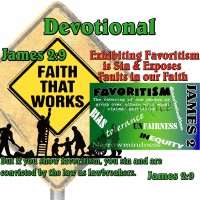

Read: James 2:9 |
In our family of three boys and one girl, I remember each of us asking, “Why do you let him/her do that when you don’t allow me to do the same thing?” Favoritism is a parenting paradox best avoided.
Obviously, showing favoritism or partiality also applies to everyday life as well. Favoritism is the preferential attitude and treatment of a person or group over another having equal claims and rights. Deep wounds can occur in our fellowship and friendships, when partiality raises its ugly head. Discrimination of any kind is no small matter.
James emphasizes the importance of the sin of favoritism in chapter two, after he laid the foundation in chapter one around the tests we face. He first spoke of trials as a test of our faith. The second test was in how we respond to temptation (link), which reveals the genuineness of our faith. The third test was can we hear, listen and do what God says (link) as an exhibition of our faith.
In Chapter 2, this test of favoritism may have been a particular sin he noted and wanted to emphasize. He takes his time to develop his point by clearly stating:
Though the subject of favoritism may sound like a trivial sin, it is/was truly important!
Man’s inclination to Partiality & Favoritism
In our modern society, partiality exists in many camouflaged forms. Though we complain when we are the victim, too often we say nothing when we are the benefactor. Only through faith and practice, can we break the cycle and seek equal justice for all. As believers, we grow when we learn to treat each person as good as or better than we would treat ourselves (Philippians 2:2)
God’s Impartiality
The Bible plainly tells us in the Old and New Testament to avoid the practice of partiality. God is not a respecter of persons (Deuteronomy 1; Acts 10:35). There are many examples of God’s impartiality:
God is also not partial when disciplining and chastening sin either. To be more like Christ, adopt his attitude and see the heart and soul and not their appearance.
Why is Favoritism a sin?
James tells us to avoid favoritism because it is a sin. God hates sin.
In case, that is not enough reason for some to avoid favoritism, James also points us to scripture. He notes the “royal law” – Royal because it is from the King of Kings – found in Deuteronomy 6:4-5 and Matthew 22:37-39. The key is to “Love your neighbor as yourself” (link). If we cannot pass this test, we are sinning – period.
Our day-to-day active vibrant faith should reflect God’s holiness and glory. We cannot hold on to faith and partiality at that same time. To hold one, we must let go of the other. Partiality is inconsistent with the Christian faith and the very nature of our impartial God. Apply the “royal law”, live by the golden rules and share our faith with everyone we meet regardless of creed, color or class.
 Favoritism never looks good!
Questions:
1.Discover –
A. Did your parents show favoritism as you were growing up? How did you handle it?
B. How do you handle favoritism when you experience it? Do you confront it or go along?
2.Develop –
A. Have you ever caught yourself showing favoritism?
B. Ask your prayer partner and friends to point out areas where you may show favoritism.
3.Demonstrate –
A. Confess existing favoritism to God and commit to do better.
B. Can you share how you plan to detect and destroy favoritism in your life via the Comment Box below?
We may be able to apply your solution in our lives!

18 Responses to James 2:1-13 – Exhibiting Favoritism is Sin & Exposes Faults in our Faith